

Planning matters

Our award winning blog gives a fresh perspective on the latest trends in planning and development.

Cutting down to size: how the new NPPF proposes to ease the burden for small sites
As part of Lichfields analysis of the draft NPPF (published for consultation on 16 December 2025[1]) this blog focuses on the changes for development of small-to-medium (StoM) sized housing sites and considers the implications for housing delivery.
Plan-making and Development Management: a proportionate approach that reduces documentation requirements
The government highlights delivery of homes on StoM sized sites as one of its “twelve key policy changes”, intending to provide clearer support for the principle of development across a wider range of locations in plan-making.
1: Planning for an effective use of land
This promotes the allocation of sites of different scales, including StoM-sized sites, and the use of design guides and design codes to establish common design principles and highlight development opportunities of sites of StoM-sized sites.
This would replace the paragraph 73 of the 2024 NPPF, which requires at least 10% of a housing requirement be met on sites no larger than one hectare.
DM1: Preparing development proposals and DM2: Information requirements.
The draft NPPF emphasises that planning requirements should be proportionate to site size, introducing a new “medium development” category in Annex C for schemes of 10–49 homes on sites of up to 2.5 hectares, supported by policy and regulatory easements intended to streamline development on sites of this scale.
The consultation states that the “medium development” category should not be subject to information requirements designed for larger developments (at pre-app or application stage), where these would be disproportionate to the scale of the proposal:
  1. Pre-application engagement: Draft Policy DM1 states that pre-application engagement should be proportionate to the nature of the scheme and those likely to be affected.

  2. Local validation lists: Draft Policy DM2 states local validation lists should only require additional information above what is required by the national decision-making policies when they are supported by local policies. Validation requirements should also distinguish between major, medium and other forms of development, to ensure they are proportionate to scale and potential impacts.
What do these changes mean? The shortage of suitable land for smaller sites and builders has contributed to the decline in SME-led housing delivery in recent years.[2] The Federation of Master Builders has estimated that, given the right conditions, the SME housing building sector could increase housing output by up to fivefold.[3] The changes in the new NPPF might go some way to help address this.
According to Lichfields’ research for the HBF’s Planning for Small Sites (2025), negotiating matters such as design and residential amenity is among the top three issues debated for urban small-site applications. [4] The draft NPPF seeks to address this - at least in part - through the extended use of design guides and design codes on smaller sites. The aim is for greater clarity on local authority expectations, reducing the scope for negotiation.
Furthermore, a greater emphasis on allocation StoM-sized sites would reduce the need for applicants to establish the principle of development on a site-by-site basis. Our research for the LPDF - Small builders, big burdens (2023) - indicates that SME developers are often required to go beyond proportionate validation and policy requirements, leading to increased financial risk and delays.[5] Reducing documentation requirements to proportionate levels would help lower upfront development costs, minimise delays, and accelerate housing delivery overall.
Our research (ibid) also concluded that a medium sized category could help “LPAs and National Development Management Policies to set more proportionate policies and evidence thresholds that are better suited to sites that are [medium sized]”. We also concluded requirement for some evidence should be a product of discussion, rather than be automatically demanded at the outset – “this should lead to case officers being more confident in deferring some of the evidence required to conditions and the reserved matters stage when funding is more readily available [for developers]”.
Affordable housing: Greater flexibility for Payment in Lieu and size standards
The draft NPPF places a strong emphasis on certainty and proportionality for StoM-sized housing sites, particularly for SME developers. Central to this are policies HO8, DM5 and PM12, which together seek to reduce risk, negotiation and delay.
HO8: Providing Affordable Housing
HO8 introduces flexibility whereby, if a proposal meets or exceeds up-to-date development plan requirements for the proportion and mix of affordable housing tenures (including the minimum proportion of Social Rent homes) a more flexible approach may be taken to the mix requirements for market homes. This flexibility could be particularly beneficial for StoM sized sites in urban London locations, allowing unit sizes to be adjusted to support development viability.
While HO8 retains the preference for on-site affordable housing, the government understands the difficulties experienced finding buyers for those properties, with uncertainty and negotiations disproportionately affecting SMEs. In the consultation document, the government is considering allowing developers of “medium development” sites to meet affordable housing requirements entirely through payments in lieu. This was a recommendation of our research for Pocket Living[6] back in 2020. This could be significant, especially on urban sites, and in London where the Government/GLA emergency measures have already highlighted affordable housing as a viability issue holding back delivery.[7]
The disposal of affordable housing to Registered Providers (RPs) has been a persistent and growing challenge on StoM-sized sites. [8] RPs are often reluctant to acquire small numbers of homes within developments, as these can be inefficient to manage and require similar staffing and management inputs without the benefits of scale.[9] This can affect developer cashflow, creating market barriers to entry and delivery.
The HBF Bid Farewell (2024) notes many RPs require at least 20 affordable homes on their sites, with larger providers often rejecting schemes with under 100 homes. This may continue to present challenges for developments of approximately 50–300 homes, which exceed the 49 homes ceiling on the proposed definition of “medium development” but may still deliver fewer than 100 affordable units. This suggests the proposed definition may still not capture the current range of viability and delivery challenges.
Development Viability: A Standardised methodology and obligations
DM5: Development Viability and PM12: Developer Contributions
The policy introduces the presumption that developments complying with up-to-date plan policies should be considered viable. Where a viability assessment is required to demonstrate that a policy-compliant level of affordable housing is not achievable, this has to be specific circumstances, such as:
  • The development is significantly different from any typology assumed in the development plan viability assessment;
  • Site characteristics differ substantially from the assumptions used to assess viability when the relevant development plan policies were prepared;
  • The development is demonstrably burdened by costs which were unforeseeable when the development plan was prepared; and
  • Site or economic circumstances have changed significantly since the development plan was prepared.
The policy also sets out a more standardised method for assessment, namely to:
  • Refer back to the viability assessment(s) that informed the relevant development plan policies;
  • Fully evidence all inputs and assumptions used, explaining any departures from the viability assessment(s); and
  • Utilise standard inputs set out in the Annex (to be added subject to the result of this consultation).
PM12 adds to this by requiring local plans to set clear, fixed expectations for affordable housing and developer contributions. Collectively, through these two policies, the government aims to standardise the planning process by reduce the time spent negotiating viability and planning obligations at the decision-making stage.
This approach could in due course benefit SME developers delivering StoM-sized sites, particularly in London, where the research by Lichfields for Pocket Living identified affordable housing and viability as key causes of delay in London, with around a third of cases affected by protracted land value and viability debates, and Section 106 negotiations often doubling determination times.[10] Greater standardisation of viability assessments and Section 106 could reduce delays and mitigate financial risk.
However, it remains unclear to what extent the viability process can be standardised, particularly as the exceptional circumstances identified in Policy DM5 may not be uncommon. In the absence of a stepped approach to affordable housing requirements for StoM sized sites, the number of viability assessments is unlikely to decrease, at least in the short term. This approach may be more effective once new-style local plans implement Policy L1 with a greater supply of StoM sized site allocations through local plans.
Standardisation of Planning conditions and obligations
Policy DM6: Use of planning condition and obligations
DM6 states that national model conditions and obligations should be used, unless there are strong reasons not to. The consultation highlights the aim to encourage consistency and simply the planning process.
As with attempts to standardise viability, this proposal could also reduce delays and financial risks for StoM sites. This was similarly highlighted in our research for Pocket Living, with smaller developers often restricted from realising returns on capital due to onerous pre-commencement conditions.
Biodiversity Net Gain (BNG): Exemptions for StoM-sized sites and supporting off-site contributions
The Government’s consultation document has set out the intention for BNG exemptions for certain site categories. The Housing Secretary pledged to introduce an area-based exemption for smaller sites that are up to 0.2 hectares and residential brownfield developments of up to 2.5 hectares. This could reduce the cost of development and slim the evidential burden required to support applications. A full consultation on this is expected in the new year.  
This move could help address issues we highlighted in the HBF’s Planning for Small Sites (2025) research, which found that 94% of SMEs had experienced delays with applications due to BNG.[11] For slightly larger sites, simpler and more accessible mechanisms for delivering BNG off-site could also support SME developers, subject to the details proposed in the forthcoming consultation.
Summary and Conclusions
Overall, the draft NPPF and accompanying consultation signal clear efforts towards a more proportionate, standardised and delivery-focused planning framework for StoM-sized housing sites.
Through clearer policy expectations, reduced documentation requirements and a set of more flexible approaches to affordable housing, viability, planning obligations and BNG, the proposed reforms have the potential to address many of the structural barriers that have constrained SME-led housing delivery in recent decades.
If implemented effectively and supported through local plan allocations under Policy L1, these changes could reduce uncertainty, negotiation and delay, lower risk and improving the viability of development on StoM sized sites, particularly in challenging markets such as London. However, the extent to which these benefits are realised will depend on how consistently the policies are applied in practice, the scope of any exemptions or flexibilities ultimately adopted, and whether exceptional circumstances continue to drive site-specific negotiations. This consultation and the forthcoming consultation on BNG early next year presents an important opportunity to ensure that the final framework fully supports the role of StoM-sized sites in accelerating housing delivery.
[2] Lichfields (2023), Small builders, big burdens, Source: Link
[3] Written Evidence of the Federation of Master Builders (2023), Source: Link
[4] HBF (2025), Planning for small sites, Source: Link
[5] Lichfields (2023), Small builders, big burdens, Source: Link
[6] Lichfields (2020), Small sites: Unlocking housing delivery, Source: Link
[7] Lichfields (2025), Two penn'orth invited: the London emergency housing measures consultations, Source: Link
[8] Knight Frank found 80% of developers are struggling to find buyers for Section 106 affordable homes, including more than 40% who say they are unable to find a single Registered Provider (RP) buyer. Source: Link               

[9] HBF (2024), Bid Farewell, Source Link

[10] Lichfields (2020), Small sites: Unlocking housing delivery, Source: Link

 
[11] HBF (2025), Planning for small sites, Source: Link

CONTINUE READING

As the London Plan turns five, will its review create a new beginning for housing delivery?
This month, the London Plan turned five years old. As most of us look ahead to the next iteration of this Spatial Development Strategy (‘SDS’) - the first under this Government’s direction of being “genuinely strategic” - we consider what this anniversary, the new Local Plans system and the new London Plan could mean for London boroughs and those looking to build new homes across London.
It is now well documented that the Mayor recognises the scale of the housing crisis in London and he has indicated that the new, slimline, London Plan is expected to seek to meet the London’s housing need in full. We watch this space with interest, to see how that will be achieved. The aim is to have a new London Plan in place by 2027/28, but there is plenty of time to influence what that will contain.
In the intervening period, there are other potential opportunities that will arise for bringing forward new homes:
  1. In certain boroughs, the Five Year Housing Land Supply (‘5YHLS’) will increase dramatically;

  2. There may be trouble ahead for those boroughs who seek to adopt lower housing targets; and

  3. There are many new opportunities to influence emerging local plans or to ensure they keep on the straight and narrow.
We consider these in this blog.
The timeline
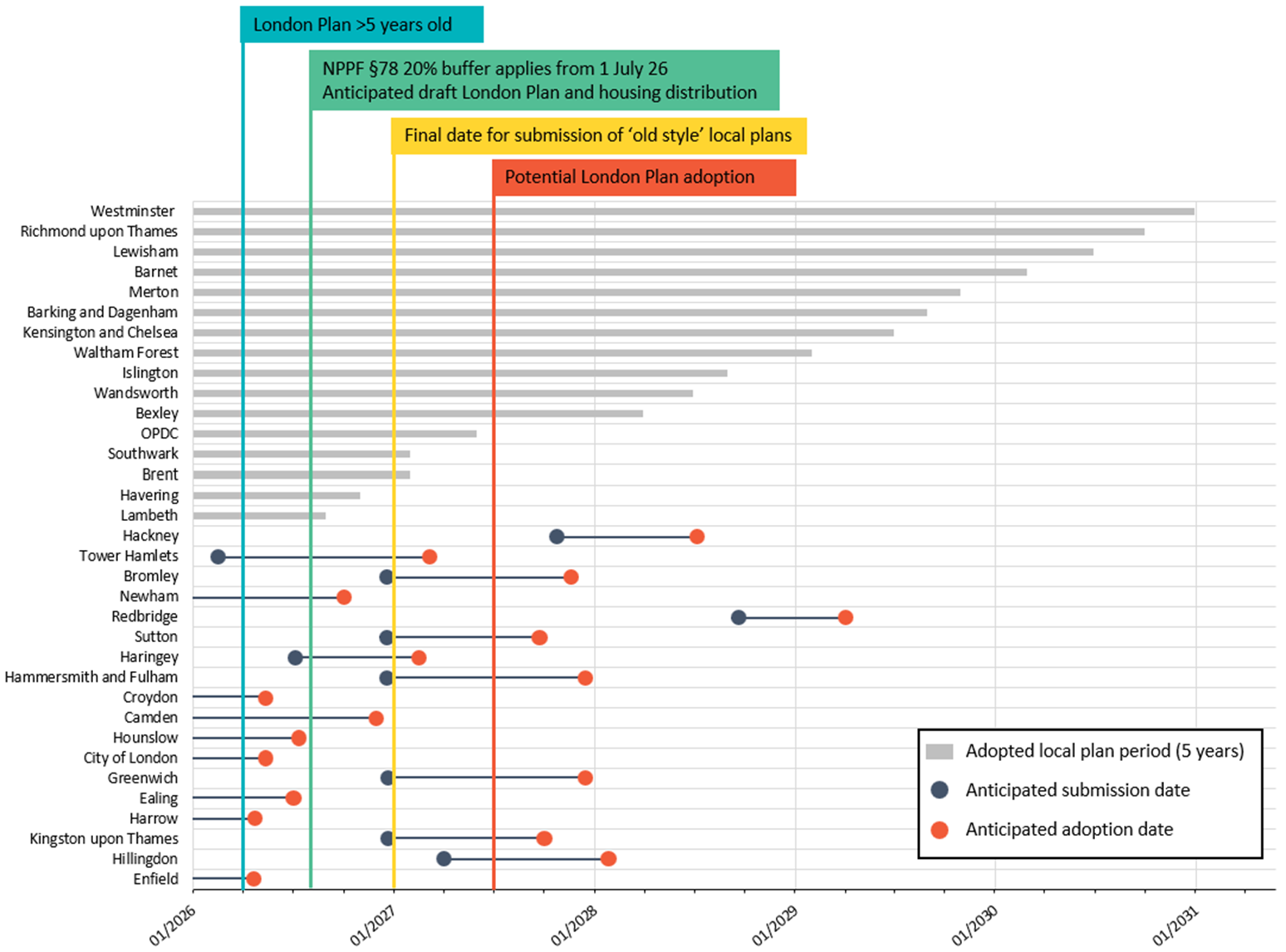
Over the next year, there will be changing circumstances at a local, London and national level which will significantly influence the housing position in London (in terms of planning). We have therefore analysed the local plan position for each London borough and in Figure 1 identify what their local plan trajectory is expected to be against key upcoming milestones. These milestones are:
  • March 2026 - London Plan becomes 5 years old and the basis of calculating the 5YHLS changes to be in line with standard method.

  • 1 July 2026 - NPPF 2024 §78c requires a 20% buffer to be applied where a borough has a housing requirement adopted in the last five years whose annual average housing requirement is 80% of less than the LHN (unless a 20% buffer is already applied).

  • Summer 2026 - anticipated publication of draft London Plan (including its proposed housing distribution, although this will have limited weight).

  • 2027/ early 2028 - GLA’s published target adoption date.
Overall findings are that 11 no. of Local Plans are in place that will run through this period. 10 no. of local plans are currently underway and due to be adopted before the London Plan is adopted and the remainder of plans will be adopted after the new London Plan. We explore the implications of this in more detail below.
The anniversary for 5YHLS


Colleagues have previously analysed the importance of this anniversary[1] and the window of opportunity it creates when measuring the 5YHLS.
Now that the London Plan is five years old, the 5YHLS measurement for decision-making depends on the status of individual Local Plans[2]. If a London borough’s local plan is already five years old, then this reverts to the standard method which is, almost uniformly, higher than the current London Plan targets.
This means that the following boroughs all revert to using the standard method LHN, which is higher than their London Plan target (until they adopt a new Local Plan), creating potential opportunities for speculative planning applications[3]
  • Bromley; Camden; City of London; Croydon; Ealing; Enfield; Hackney; Hammersmith and Fulham; Haringey; Harrow; Hillingdon; Hounslow; Kingston upon Thames; Redbridge; and Sutton


July 2026 – 20% buffer


A new 20% buffer was introduced by the Government in the 2024 NPPF (§78c) to help address shortfalls between recent local plans and the new standard method. This new buffer to the 5YHLS calculation will apply to seven London boroughs where their housing target is 80% or less than the LHN and a 20% buffer is not already applied by virtue of the 2023 Housing Delivery Test results:

  • Barnet; Bexley; Brent; Merton; Waltham Forest; Wandsworth; and Westminster
Combined with the 2023 HDT results, of the boroughs with a plan adopted in the past five years, we anticipate that all will have a 20% buffer applied.
For these boroughs, there could be greater scope to demonstrate an unmet housing need – creating the future opportunity for the broader presumption in favour of development in the draft NPPF to be applied.
Emerging Local Plans


The Government has announced that local planning authorities can submit plans under the existing system until 31 December 2026[4]. While we move to a faster and more streamlined plan-making system with great anticipation, this deadline is having a bearing on boroughs with local plans in preparation.
We expect the following boroughs to try and submit plans for examination before this deadline:

  • Bromley; Greenwich; Hammersmith & Fulham; Kingston upon Thames and Sutton

Failure to achieve this deadline will mean that boroughs then need to transition to the new Local Plans system promptly, including repeating relevant plan-making steps, so the stakes are high for them to achieve this. This will further delay having an adopted plan in place, when we are meant to be working with a ‘plan based’ system.
To understand the cumulative effect of the transition to the new Local Plans system and layering the timeline for the preparation of the new London Plan, we have reviewed some case study boroughs in more detail:
Hillingdon


Hillingdon’s original ambition was to submit a local plan under the existing plan-making regime, by December 2026. However, in a Cabinet Report[5] officers recommended delaying this process and instead progressing under the new plan-making system.
This approach was, partially, based on Hillingdon’s LHN more than doubling from the London Plan target, and a recognition that the plan was being prepared in advance of the Mayor’s apportionment of London’s LHN to each individual borough. This apportionment could require substantial revisions and further consultation – they considered it is prudent to delay publication of the draft plan, so that the apportioned targets can be considered.
The indicative timetable now proposes submission in September 2027 and adoption in April 2028 which would tie in closely with the London Plan.
Camden


In the alternative, LB Camden submitted its plan for examination in October 2025. However, its proposed housing target is 11,550 additional homes from 2026/27 to 2040/41 – an average of just 770 homes per annum (74% of the annual London Plan target, 1,038 dpa between 2019-29).
This drop in housing requirement was challenged by the GLA[6]. The GLA note that the “current London Plan does not meet London’s identified need and therefore the overall amount of housing required annually should not be expected to reduce.”
The GLA also state that the text at paragraph 4.1.11 of the London Plan[7] is “now considered to be out of date”, in the context of working towards delivering 88,000 homes per annum. The GLA stated that boroughs “should seek, as a minimum, to roll over the current London Plan target beyond 2028/29, including any shortfall accrued to date, and to continue to take proactive measures to increase housing supply.”
The GLA’s position here demonstrates that it is seeking to try and boost housing supply through local plans now – in anticipation of increases in the next London Plan.
While Camden’s position was ultimately agreed in the statement of common ground between the GLA and Camden it could result in a Local Plan being adopted with a materially lower housing target than the current position. This will ultimately be superseded by the targets in the next London Plan when it is adopted, but it will effectively ‘bake in’ a housing strategy and site allocations at this lower level for the duration of the plan.
It is also notable that 25 boroughs[8] responded to Camden’s duty to co-operate request and all confirmed that they are not in a position to help Camden identify a 5YHLS.
What this all means for local plan preparation?


The cyclical lag between local plans, the London Plan and, now, the application of the new standard method, continues to create a complex picture of the housing requirement across the capital.
It is expected that the Mayor will redistribute the 86,000 homes per annum LHN for London across boroughs, so that this is met in full. However, achieving this will be reliant on having local plans that are prepared with sufficient allocations and ambition to match this requirement. The current picture is that most local plans will be based on out-of-date housing targets, including those that are continuing to be prepared.
Our analysis of borough’s local plan timetables (Figure 1) indicates that:

  1. there is a group c.11 boroughs with adopted local plans that will remain less than five years old through to 2029-31.

  2. there are c.15 boroughs in the preparation of a local plan now, five of which are seeking to submit ahead of the 31 December 2026 deadline for the current plan-making system. Concerningly, a number of these boroughs are seeking to adopt targets beyond 2029, which will be below the current London Plan target, let alone seeking to meet their LHN. It is unclear if Inspectors and the Mayor will expect these boroughs to meet a draft LHN redistribution figure, or if this will only be applied closer to adoption of the London Plan.

  3. the remaining c.8 boroughs are expected to progress under the new local plan-making system, and their timescales are likely to coincide with the Mayor’s LHN redistribution figure being at an advanced stage. This should lead to the expectation that those boroughs prepare plans to meet this need.


Concluding thoughts


Housing distribution: In order for boroughs to begin to prepare local plans that contribute to achieving London’s LHN as a whole, the distribution of those 86,000 homes cannot come soon enough. This is necessary for effective planning and to avoid local plans being adopted which ‘bake in’ anomalous housing numbers for the next plan period.

HDT methodology: Positively, the Government is proposing to amend the Housing Delivery Test rule book, so that the relevant housing requirement is derived from whichever is the most recently adopted plan (whether it is a spatial development strategy or borough/district-level local plan). If implemented, this will address the risk of boroughs being measured against materially lower targets for the HDT.

5YHLS methodology: The next London Plan will return to primacy as the basis of the 5YHLS from its adoption (likely late 2027/early 2028). However, until then, those boroughs with local plans that are more than five years old will revert to the full LHN for this measure. Based on the potential implication of failing the 5YHLS[9], we anticipate that this will be most relevant to Camden; Hillingdon; Hounslow; Redbridge and Tower Hamlets.

Local elections: with all London borough councillor seats up for election in May 2026, there is the possibility for new local plan committees to introduce yet more uncertainty to this position. This could mean potential delays in local plan preparation, as new councillors/parties seek to understand and influence their local plan.
Clearly, given the complexities of considerations over the next year, the housing position needs to be considered on a borough-by-borough basis, but there are expected to be significant opportunities, both through speculative applications and through engaging in local plan consultations in the context of significant increases in housing requirements.

[2] Until the next London Plan is adopted (stated by the GLA to be 2027,
https://www.london.gov.uk/programmes-strategies/planning/london-plan/next-london-plan and in the more recent Hounslow/GLA statement of common ground as ‘early 2028’).

[3] It is recognised that for some boroughs, this is tempered by existing failings in the Housing Delivery Test, but it will add further weight to the importance of housing delivery.

[4] https://www.gov.uk/government/news/new-local-plan-system-launching-early-2026-latest-update

[5] Cabinet Report 15 January 2026. https://modgov.hillingdon.gov.uk/documents/s65395/05%20-%20REPORT%20HC%2020251124%20Local%20Development%20Scheme%202025%20December%20Cabinet%20Report%201.pdf

[6] https://www.camden.gov.uk/documents/d/guest/sd19-statement-of-common-ground-with-the-gla

[7] Paragraph 4.1.11 of the London Plan requires that housing targets beyond the 10-year period of the London Plan targets should draw on the 2017 SHLAA findings, any local evidence of identified capacity.

[8] Barnet, Bexley, Brent, Bromley, City of London, Ealing, Enfield, Greenwich, Hackney, Haringey, Havering, Hillingdon, Hounslow Islington, Lambeth, Lewisham, Merton, Newham, Redbridge, Richmond, Southwark, Tower Hamlets, Waltham Forest, Wandsworth and Westminster

[9]Based on Planning Resource 5YHLS data, these boroughs could see their position fall below five years.

CONTINUE READING

Ageing Gracefully: The NPPF Consultation and Older Person’s Housing
Since its first publication in 2012, the National Planning Policy Framework (NPPF) has encouraged local authorities to establish the need, size, type and tenure of housing for different groups, including older people. As set out in Martin Taylor’s blog, the 2025 NPPF consultation (16 December 2025[1]) does not waver from this core principle, which seeks to secure a diverse mix of homes to meet the needs of different groups through the planning system.


Despite this longstanding approach, Lichfields’ Solutions to Age Old Problem Insight identified both in 2019 and the 2024 update that whilst many local plan policies refer in general terms to the needs of older people, few set out a specific requirement for the level of older person’s housing that could be provided or contain allocations for the development of such accommodation. Similarly, only a few local authorities have tended to monitor the delivery of specialist housing for older people. As of 2019, just 14% of development plans in England had policies that identified a requirement for housing for older people and just 8% of English development plans included allocations for housing for older people. The 2024 update showed an improvement in identified specialist housing requirements within development plans to 48% but the number of plans with allocations for specialist housing remained largely static at 9%.


The ageing population has been a longstanding and significant contributor to household growth. The 2022-based Household Projections shows that the number of over-65 households in England is anticipated to grow by over 3 million between 2022 and 2047, equivalent to 57% of all household growth over this period.


Importantly, older people generally live in smaller households (single or couples) so the housing implications of the population increase will be disproportionately significant. The provision of specialist accommodation for older people can provide social and economic benefits by increasing social interaction, providing safety and security, and helping to meet care needs, whilst also helping to free up general needs housing. It therefore represents an important part of the puzzle to solving the housing crisis.


This blog considers whether the suite of new Plan-making and Decision-Making Policies within Section 6 of the draft NPPF will require local authorities to properly plan for older person’s housing and, in turn, deliver the step-change in delivery that is required to meet needs.


What does the new NPPF say and how is it different?


There are four key policies within the draft NPPF which consider housing for older people; three of these are plan-making policies which seek to provide greater clarity to local planning authorities over what is expected at the plan-making stage. The fourth is a National Decision-Making Policy (NDMP) which should be used by local planning authorities in the determination of planning applications.


The draft policies are not substantially different to the current approach within the NPPF, but the restructuring helps provide greater clarity for plan-making and decision-taking.


Assessing need


Draft Plan-making policy HO1 “Assessing the Need for Homes” largely reflects the approach set out in paragraph 63 of the current NPPF (2024), which requires development plans to assess the size, type and tenure of housing or other accommodation to meet the needs of different groups, including older people.


Whilst the overall number of homes needed is to be addressed through Spatial Development Strategies (SDSs) (part 1 of HO1), part 2 of Policy HO1 states that size, type and tenure requirements should be determined “at the most appropriate level”. This will allow plan-making authorities to adjust their policies to encourage a particular housing mix to respond to local needs. Taking the West of England SDS authorities as an example, it would seem inappropriate for the same approach to be taken to older person’s housing delivery in Bristol, where less than 13% of people are aged over 65, and North Somerset, where almost a quarter of residents (23.9%) are aged 65 or over.


This element of flexibility within Policy HO11 is welcomed but care must be taken to ensure that planning for specialist forms of accommodation does not ‘fall through the cracks’ with the SDS deferring to the local plan and then for local authorities to fail to pick up the mantle.


As recommended in Lichfields’ Insight, clear guidance will need to be published on how housing for older people is calculated when assessing local housing need, with the current 2019 guidance pre-dating the standard method.


It is important to note that the standard method identifies a minimum housing annual need figure for residential in Use Class C3 and therefore an assessment of need for any older person’s housing falling within Use Class C2, such as care homes, should be in addition to the standard method figure.


It will be important for site promoters and developers to evidence the need for development at both SDS and local plan preparation and examination and make the case for care, retirement and sheltered housing. Lichfields’ Carepacity product can provide up-to-date evidence to assess the need for housing for older people. This will ensure that local authorities prepare development plan policies and identify suitable allocations that are robust in accordance with draft policy HO1.

Identifying sites


The draft NPPF’s Plan-making policies HO4 “Land for large scale residential and mixed-use development” and HO5 “Meeting the needs of different groups” both set out specific requirements to identify sites or parts of sites capable of supporting delivery of housing for specific groups, such as older people.


This is a positive step as it arguably provides the greatest certainty of delivery, ensuring that there are clear expectations for the land use on a given site. The delivery of older person’s housing should be embedded into the allocation policies for large-scale residential sites and this will ensure that development is located in the most sustainable and suitable locations for older person’s housing. Given the low proportion of local plans that currently contain such allocations, this policy could present a step-change in the identification of sites appropriate for older person’s housing.


Policies HO4 and HO5 both set out that policies for a mix of tenures, and therefore consideration of specialist forms of housing, need to be provided on sites for 150 homes or more. Reflecting the housing needs for older people within strategic allocations is important for a number of reasons, including that strategic allocations offer the economies of scale which can often support a mix of different housing types (which might not be viable elsewhere) and thereby contribute to more diverse and sustainable local communities.


However, given the prevalence of viability issues within the residential sector and potential complexities of delivering specialist forms of accommodation alongside general market and affordable housing, the 150-home threshold is unlikely to be appropriate as a national benchmark. Instead, it should be set at a local level to reflect local circumstances and the outcomes of plan-making authorities’ viability assessments to inform local plan preparation.


Delivering the needs of residents


Policy HO9 is a new NDMP which would provide greater clarity on requirements for different specialist forms of accommodation, including older person’s housing. The draft Policy HO9 part 1a) sets out two key aspects for housing for older people:

  • Part i requires a sustainable location with access to frequently used services via sustainable transport; and,
  • Part ii requires delivery of housing to M4(2) or M4(3) accessibility standards.
It should be noted that within the supporting text to the consultation, the government proposes a national minimum target of 40% of new housing over the course of the Plan period to be delivered to M4(2) standards (Policy HO5). It should be confirmed whether this minimum applies to the local authority need or at site level. Once confirmed, this should be explicit within wording of Policy HO9 or deferred to plan-making authorities to determine an appropriate level based on local requirements.


Policy HO9 part 1b) also provides helpful guidance which will be of relevance to developers of older person’s housing. It suggests that “specialist community-based accommodation”, which could include Integrated Retirement Communities, should be supported by a management plan which will provide a “safe and secure environment for residents”. Whilst there is merit in securing the safety of residents, there is a lack of clarity on how this is would be assessed at application stage and what criteria might need to be met. Specialist community-based accommodation is not defined within the draft NPPF and some clarity on this would be helpful.


As a non-statutory NDMP, Policy HO9 would act as guidance and must be read alongside any policies of the adopted development plan, which would be the basis for decision-making. The consultation asks whether NDMPs could be introduced as statutory in “the most effective manner”, so it will be important to monitor this and other NDMPs going forward.


Summary and Conclusions


The NPPF consultation takes positive steps to address the lack of clear policy direction at a national and local level for older person’s housing, however this does not feel like the significant change needed to considerably boost the supply of specialist accommodation for old people.


It is vital that a positive policy landscape is shaped to address the significant needs of the older population and to help free up family housing. In the light of the new policy context, Carepacity will play an even greater role in supporting developers by providing evidence for a robust needs case when assessing housing need in accordance with draft policies HO1 and HO5.


Policies HO4 and HO5 encourage plan-making authorities to allocate sites for specialist forms of accommodation. Lichfields’ evidence shows this is severely lacking in adopted local plans and so that change in approach is welcomed. These policies will help to provide greater certainty of delivery and clearer expectations for the land use, type, mix and tenure on a given site.


The Government should implement Lichfields’ three recommendations to help boost the supply of older person's housing:


  1. Planning Practice Guidance (PPG) “Housing for older and disabled people” was last updated in 2019. It is vital that this is revised alongside the publication the NPPF to provide clear guidance on how housing for older people should be considered when assessing housing need, making clear where it forms part of, and where needs are in addition to, the standard method.

  2. Greater certainty of delivery should be provided by requiring plan-making authorities to allocate sites for specialist accommodation where there is an identified need. This should include updating PPG which currently states “It is up to the plan-making body to decide whether to allocate sites for specialist housing for older people”.


  3. The PPG should be updated to clarify how older people’s housing should be considered within CIL Charging Schedules and whether other obligations such as affordable housing should be sought.


Please get in touch if you would like to understand more about the draft NPPF and how the proposed changes could affect your residential developments, or if you would like assistance in preparing representations to the consultation.


The consultation closes to representations on 10 March 2026.
Footnotes


[1] National Planning Policy Framework: proposed reforms and other changes to the planning system

CONTINUE READING

Will Planning Policy in Scotland deliver the homes we need?
Planning policy in Scotland is set in the Development Plan and when it was adopted in February 2023, the 4th National Planning Framework (NPF4) became part of the development plan.  Unlike its predecessors NPF4 policies are a consideration alongside Local Development Plan (LDP) policies for all planning applications.  If there is conflict between local and national policies, it is the newer policies that take precedent - for most authorities, the national policies override the local polices.


The adoption of NPF4 has necessitated the development of new LDPs in all 34 local planning authorities in Scotland and these should be in place by May 2028.


This is important for new housing delivery because Policy 16 of NPF4 essentially prevents (except in limited circumstances) the bringing forward of housing sites that are not already allocated in an LDP.  This would not be a problem if all LDPs were up to date and had sufficient allocations in them.  However, they are not and so we are largely reliant on out-of-date LDPs and what is left of the land that they originally allocated.  Furthermore, some of these LDPs never had enough housing land allocated in the first place and instead relied on a release policy to meet any shortfall. A release policy now superseded by NPF4 Policy 16.


New LDPs can’t come soon enough - we are in the midst of a housing emergency after all!

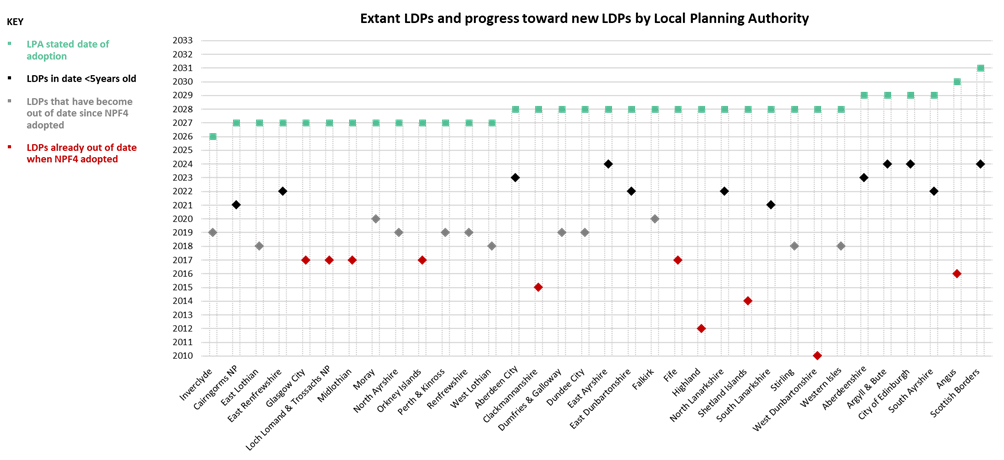
Here is the state of play:

  • 10 of 34 LDPs were already out of date when NPF4 was adopted in 2023
  • 12 have become out of date since NPF4 was adopted
  • 2 more will become out of date in 2026
  • 10 will still be in date by the end of 2026


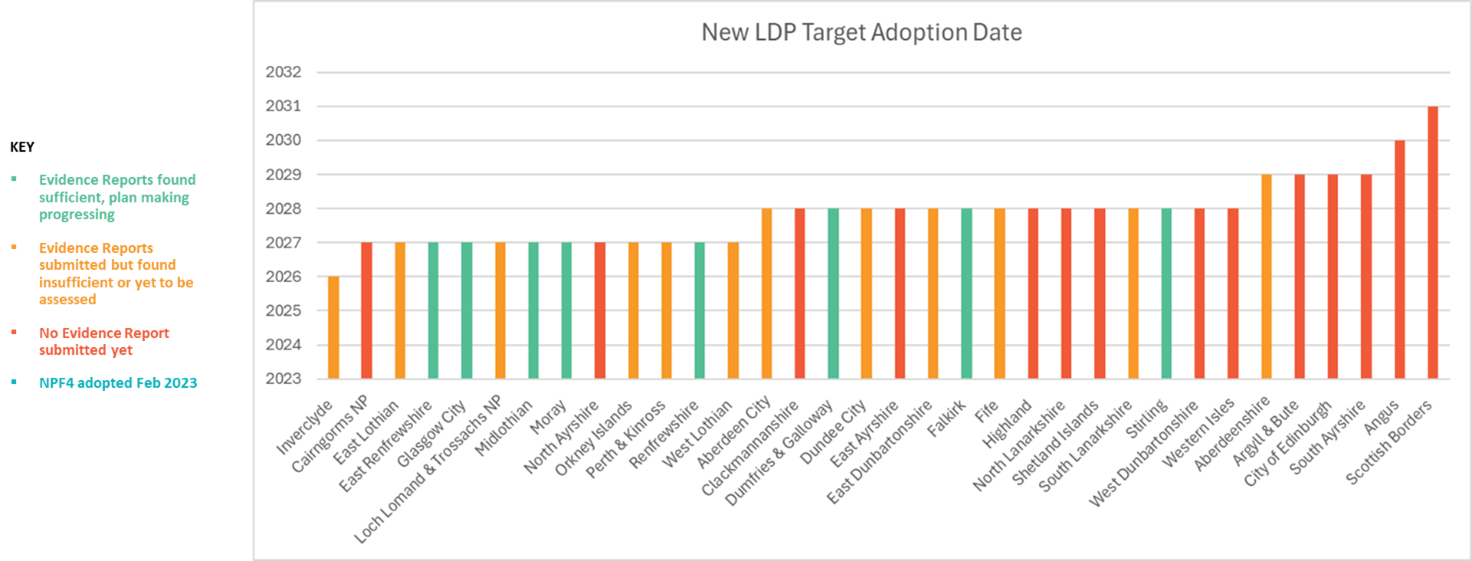
Based on published Development Plan Schemes 6 LPAs won’t have their new LDP in place by the May 2028 deadline.  More recent reporting through the Scottish Government’s NPF4 delivery programme report[1] indicates that this position has worsened, with up to 14 authorities now anticipated to miss that deadline.


This matters for housing delivery. Sites allocated in out-of-date LDPs should have come forward by now. Where they have not, there are often viability, infrastructure, or market reasons why they haven’t. Under previous policy frameworks, there was greater scope for alternative sites to come forward to address shortfalls. Under NPF4, that flexibility is much more limited until new allocations are made through new LDPs.


The new plan-making process itself introduces an additional stage. Authorities must now submit an Evidence Report to the Scottish Government for assessment before progressing to the preparation of the plan. Of the 34 authorities, 22 had submitted Evidence Reports as of January 2026, but only 8 have been found sufficient to proceed to the next stage of plan preparation.


The following illustrates the authorities’ anticipated timescales for the adoption of new LDPs, where they are at in the process and their progress to date is highlighted by the coloured bars.


Taken together, this suggests that relatively few new LDPs — and therefore relatively few new housing allocations — are likely to be in place by May 2028. 


So, is this having a negative effect or does all this not really matter that much?


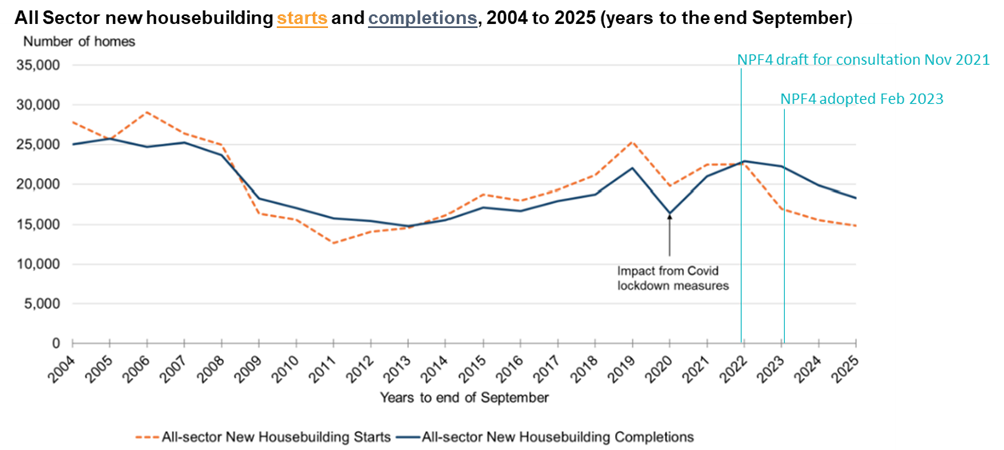
Scottish Government data on housing starts and completions usefully illustrates what has been happening in terms of new housing delivery.


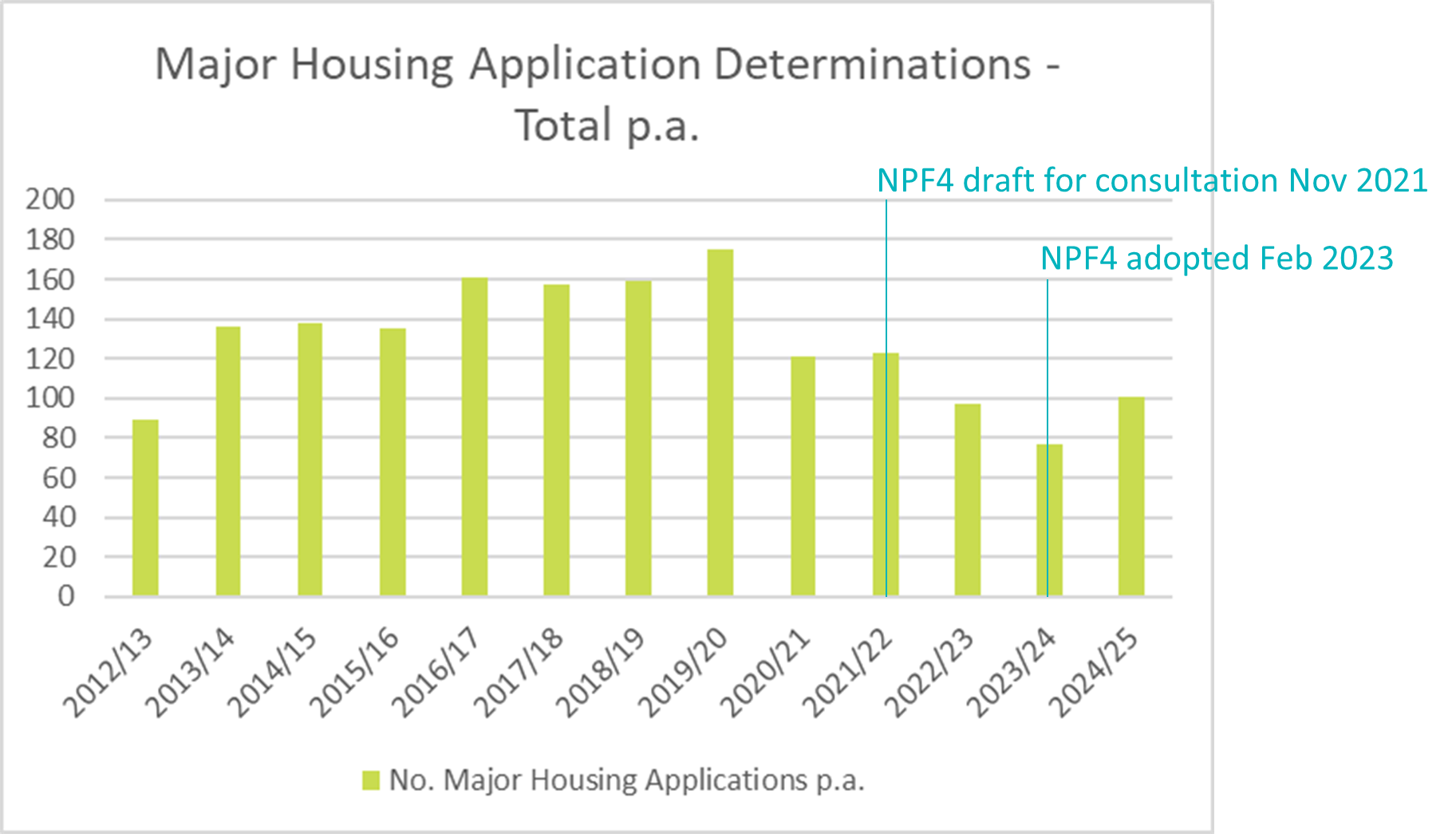
Housing starts peaked in 2019/20. While the Covid-19 pandemic clearly influenced activity in 2020/21, the reduction in starts since the consultation and adoption of NPF4 is notable. Between 2023 and 2025, average housing starts were just over 16,000 per year, compared with an average of almost 20,000 over the preceding decade.


Year-to-date figures for September 2025 show fewer homes completed (down 8%) and fewer homes started (down 5%) compared with the previous year.

A similar pattern is visible in the number of major housing applications (50+ homes) being determined. From a peak in 2019/20, the average number of determinations between 2023 and 2025 having fallen to 89 from the previous ten-year average of 140. This is important because it indicates a reduction in the pipeline of consented, deliverable sites that will translate into starts and completions in future years.


This all matters because there is clearly a dwindling number of sites coming forward for new housing development and there is inevitably a time lag between new allocations and LDPs being adopted and new homes being built.


Lichfields’ award-winning research[2] into housing delivery found that, in England and Wales, sites of 50-99 new homes take on average 2.3 years to deliver their first new home, for sites of 100-499 new homes this increases to 3.2 years.  When we looked at housing delivery in Edinburgh[3] over a 5-year period from 2016 to 2021 the timescales were similar.


When this is combined with the time required to prepare and determine a major planning application — determination is currently averaging around 44 weeks — it is reasonable to assume that a newly allocated site might take around 18 months to secure permission, followed by a further 2–3 years before first completions.


Based on this it is unlikely that there will be an uptick in planning applications for new homes before 2030 and therefore no uptick in delivery until 2032/33.


Ironically, NPF4 will become out of date in February 2033 and be up for review!


So where does that leave us?


  • There has been a reduction in permissions for larger housing sites since the adoption of NPF4

  • Housing starts are on a downward trendPolicy 16 significantly limits the development of non-allocated sites

  • The preparation of new LDPs is taking time, meaning there are limited opportunities for new allocations in the short term

  • There are limited transitional mechanisms to support new housing delivery while plans are being prepared

  • Even once new sites are allocated, there will be a considerable lag before homes are delivered

  • By the time these new allocations begin to deliver homes, NPF4 itself will be approaching ten years old and due for review


Will current planning policy deliver the homes we need and address the current housing emergency?


In short it is unlikely.


What is more likely is that Policy 16 will prevent the houses being built that the country needs now to address the housing emergency.


Scottish Government are putting in place measures to tackle the affordable housing element of the problem – we have the Housing Emergency Action Plan and the just announced new agency More Homes Scotland that will come into force if the SNP are still in power after the May elections. But interim measures to stop planning policy being a blocker of All Tenure Starts and Completions is also urgently needed.


So, for the near future our housing land supply is that that was allocated by current plans (22 of which are out of date) and no more, this can only stifle delivery.
Footnotes


[1] National Planning Framework 4: delivery programme V4 - gov.scot


CONTINUE READING