
Planning matters

Our award winning blog gives a fresh perspective on the latest trends in planning and development.

The Government’s BNG consultations explained (and why you should care)
The BNG system has an important role to play in improving and enhancing natural habitats, and ensuring development has a measurably positive impact.[1] The statutory Biodiversity Net Gain (‘BNG’) requirement came into force in the English planning system in February 2024, seeking to ensure that habitats for wildlife are left in a measurably better state than they were before development took place. As a result, it is now mandatory under Schedule 7a of the Town and Country Planning Act 1990 for relevant developments to deliver a 10% BNG on the value of all habitats within their redline boundary (known as the ‘biodiversity baseline’).
16 months on from the introduction of the mandatory BNG requirement and we’ve learned how to navigate the statutory biodiversity metric, appreciated the delivery of on- and off-site compensation, and rolled with the punches of varying validation requirements. We’re also starting to see the discharge of BNG planning conditions from the first wave of mandatory BNG developments.[2]
On 28 May 2025, the government launched two consultations relating to BNG, giving stakeholders the opportunity to suggest how the existing system could be improved, and how BNG could apply to major infrastructure schemes:


  1. Improving the implementation of biodiversity net gain for minor, medium and brownfield development; and

  2. Biodiversity Net Gain for Nationally Significant Infrastructure Projects (‘NSIPs’) (which have to date been exempt).


A comprehensive understanding of the proposed changes, and proactive engagement with the consultation is vital, as feedback will contribute towards improving the overall BNG approach, streamlining the delivery of development in turn.
To assist, we have summarised the key proposals and provided our initial thoughts on the two consultations.


Whistle-Stop Guide to the BNG Consultations


Consultation 1 - Improving the implementation of biodiversity of net gain for minor, medium and brownfield development[3]
This consultation seeks views on options to improve the implementation of BNG for relevant developments  including extending exemptions, simplifying the small sites metric and easing access to the off-site market.
The key proposals upon which views are sought are outlined below under topic headings.
 
Exemptions:

  • Replacing the custom build/self-build exemption with a single-dwelling exemption;
     
  • Increasing the de minimis exemption from 25 sqm of affected habitat to 50, 100, 200 (or some other figure);
     
  • Exempting all but major development (i.e. the pre-2 April 2024 situation); and
     
  • Introducing a new exemption for temporary development granted for up to 5 years.


Minor developments:

  • Relaxation of the biodiversity gain hierarchy so that offsite and onsite biodiversity gains are treated equally;
     
  • Removing the distance penalty for offsite compensation (the spatial risk multiplier); 
     
  • Relaxation of the trading rules for some minor development;
     
  • Giving local authorities discretion to disapply the requirement to deliver BNG for watercourses under specified circumstances.
  
Other:

  • Updated definition of Open Mosaic Habitats and ability to use alternative compensation arrangements;
     
  • Several proposed changes to the Small Sites Metric; and
     
  • Increasing the distance whereby no penalty is applied to offsite compensation.
 

Consultation 2 - Biodiversity Net Gain for Nationally Significant Infrastructure Projects[4]


This consultation seeks views on the implementation of BNG for NSIPs.
The Government propose that NSIP schemes deliver a 10% BNG from May 2025, and the consultation provides draft model text for core ‘biodiversity gains statements’ that will be applied to each NSIP sector. Biodiversity gain statements will set out the biodiversity gain objectives for each NSIP type, and eventually be incorporated into the relevant National Policy Statements (‘NPS’).
To ensure proportionality and consistency, BNG will be implemented for all onshore NSIP sectors, and will apply to any temporary, permanent and associated development included within the DCO site boundary (‘order limits’). Marine NSIPs beyond the intertidal zone are not currently included within the scope of the mandatory requirements for BNG.
 
The consultation suggests the following:
 
Evidence required for submission and decision making:

 
  • Under the proposed NSIP scheme, a Biodiversity Gain Plan (BGP) demonstrating how BNG will be delivered and a completed biodiversity metric calculation must be submitted with the application, rather than at the post-consent stage, although there will be an ability to update and finalise BGPs post consent.
  
Calculating BNG:

 
  • NSIPs must use the statutory biodiversity metric to calculate biodiversity value for the purposes of biodiversity net gain.
     
  • The statutory biodiversity metric user guide will be updated ahead of BNG becoming mandatory for NSIPs, to provide additional details on how the metric can be applied for NSIPs.
  
Delivering BNG:

  • Delivering BNG for NSIPs will differ from BNG for development granted permission under the TCPA 1990. Applicants will be able to deliver BNG on-site or off-site in the first instance, and by purchasing statutory biodiversity credits as a last resort.
 

Reflection on the consultation

Lichfields welcome the consultations, which demonstrate the government’s commitment to finding a pragmatic way forwards to striking an appropriate balance between delivering development and enhancing biodiversity. The introduction of the statutory BNG requirement has been a big change for the planning system and has, inevitably led to some significant challenges, particularly on smaller projects and on some brownfield sites. We believe the consultation represents a positive step forwards in addressing some of these challenges whilst not losing focus of the need to deliver meaningful gains in biodiversity.
We are pleased to see the BNG for NSIP consultation, having waited some time for this guidance to be released. It provides some clarity on how BNG will work in relation to NSIP development, with some key differences to the system operating for developments subject to planning permission.
 

How we can help


Lichfields’ specialist in-house BNG team have been busy scrutinising the consultations and are able to assist with making representations.
If you have any queries regarding the new government consultations, or navigating the BNG system more generally, please get in touch. We look forward to working with our clients at this stage in the process and hearing your thoughts on the consultations.
Both consultations close at 11:59pm on 24 July 2025.
  

Footnotes


[1] Department for Environment, Food & Rural Affairs (2025) Biodiversity net gain for nationally significant infrastructure projects. Available at: https://www.gov.uk/government/consultations/biodiversity-net-gain-for-nationally-significant-infrastructure-projects 
[2] Overhead, H (2025) As BNG turns 1 is the system toddling forwards or still giving us sleepless nights? Available at: https://lichfields.uk/blog/2025/february/12/as-bng-turns-1-is-the-system-toddling-forwards-or-still-giving-us-sleepless-nights 

[3] Department for Environment, Food & Rural Affairs (2025) Improving the implementation of biodiversity net gain for minor, medium and brownfield development. Available at: https://www.gov.uk/government/consultations/improving-the-implementation-of-biodiversity-net-gain-for-minor-medium-and-brownfield-development 

[4] Department for Environment, Food & Rural Affairs (2025) Biodiversity net gain for nationally significant infrastructure projects. Available at: https://www.gov.uk/government/consultations/biodiversity-net-gain-for-nationally-significant-infrastructure-projects 

CONTINUE READING

Spending Review signals optimism for economic and housing growth

Spending Review signals optimism for economic and housing growth

Richard Coburn, Edward Clarke & Sakhi Sumaria 11 Jun 2025
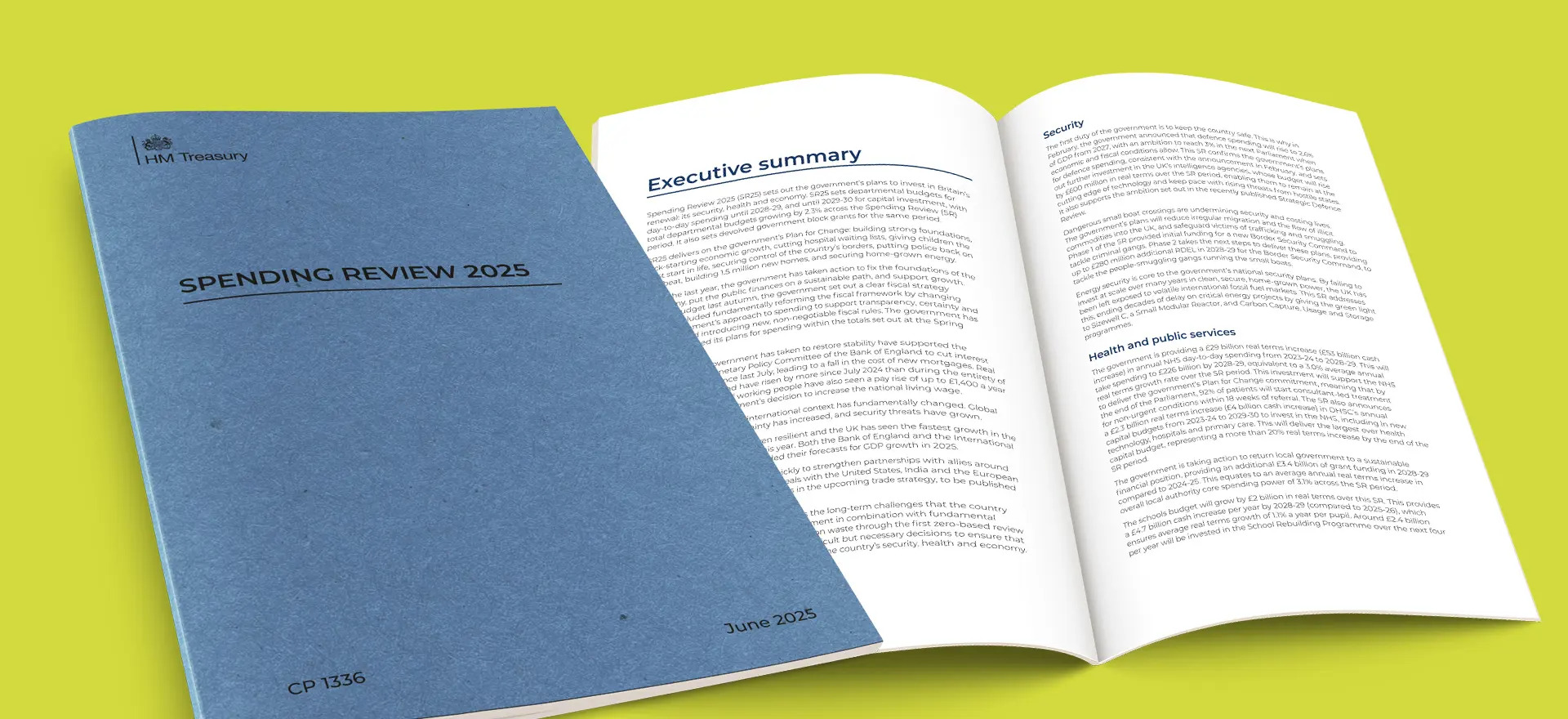
The much-anticipated Spending Review delivered by The Chancellor to Parliament today has brought with it a cautiously positive outlook for the development and regeneration sectors albeit not without a sting in the tail.   With these sectors in mind, our key takeaways are captured in four key themes all of which will be a primary focus for increased public sector investment in the period up to 2029:
  • Energy & defence;
  • Places & communities;
  • Social & affordable housing; and
  • Transport infrastructure.
 
Energy & defence
Without doubt the large capital injections for defence, security and energy will support significant economic and housing growth in key clusters across the country.  This will include the stimulation of supply chains and skills development programmes throughout the UK, irrespective of where the major projects themselves are located.
Whilst (hopefully) not Trump-infected, The Chancellor dropped plenty of straplines which could be construed as ‘Making Britain Great Again’!   Using the saving of British Steel as an example, she highlighted that the Spending Review was one which aimed to encourage ‘buying, making and selling more in Britain’.  Similar sentiment was captured by her aim of making the UK a ‘defence industrial superpower’ and that ‘energy security means national security’.    This industrial drive is backed by a commitment for increased Government R&D expenditure to £22 billion per year to 2029.
The thrust of The Chancellor’s message to restore advanced industrial capacity and autonomy to the UK where it can be viable to do so is encouraging from an economic development perspective.  This approach is supported by a longer-term approach to Government investment although political sceptics can be forgiven for not being convinced!
Lichfields will comment further on the implications of the final Industrial Strategy when it is published in the coming weeks. 
Places, communities & business cases
 
The Spending Review marks a revitalised and seemingly serious Government commitment to taking a place-based approach to investment, not least through the parallel publication of the findings of the Treasury Green Book Review (Green Book Review 2025: Findings and actions - GOV.UK). The Green Book specifies how all projects and programmes promoted by the public need to be appraised.  In doing so, it sets the framework for developing the business cases which must underpin decisions to invest or not.
Despite much political lip-service over the years, the Green Book Review acknowledges that the current guidance does not properly address the economic disparities that are evident across the country.  Indeed, the Review explicitly states that ‘…many places have simply not received the investment they need to grow and flourish’.   Moreover, it is candid and honest by highlighting that: ‘By design, business cases typically answer the question – what is the best way to undertake this project, rather than what is the right project to improve growth in this area?”.  Positively, it sets out the key areas for action that will inform a subsequent update to the Green Book and thus the approach which will need to be taken to business cases aimed at ‘winning’ public sector funding for projects.  We keenly await the outcome the Review and are optimistic that, compared to the last decade, the changes could ensure Government funding programmes aimed at regeneration and economic growth projects in the coming years are much more effective and targeted at the places which need it most.
Reflecting on the funding mechanisms applied by Government over the last decade, Lichfields will soon be issuing an Insight paper which seeks to provide guidance on how local authorities and other bodies can improve the business cases required to access public sector funding.  
This fresh endorsement of a strongly place-based approach has been immediately translated into funding programmes promised today by the Chancellor.   She has committed to providing a 10-year capital settlement through a new local growth fund, investing in up to 350 of the most deprived communities in the UK, confirming additional funding for mayoral strategic authorities through the Devolution Priority Programme and establishing the Growth Mission Fund.  Whilst a budget has not yet been specified, the latter is designed to fast-track sound local growth projects that have previously failed to attract funding. 
The Government’s intentions for places are clear: deliver growth where it is needed the most. This approach to funding hopefully will put local communities first and remove bureaucratic barriers to investment by ensuring Government guidance provides a proportionate framework for projects to make the case for investment, giving schemes a fighting start to secure the funding they need.
A key challenge for Government will be to ensure that access to these funds remains fair and equitable. In their Autumn Budget 2024, the Government committed to reforming local growth funding within Phase 2 of the Spending Review, including moving away from a competitive bidding process[1]. Today’s Spending Review made no clear mention on the structure of funding programmes in the coming years.  In order for Government to deliver on its commitment to places, it is imperative that there is a step change in the administration of funding, shifting away from a competitive to a more collaborative process.
Social & affordable housing
Housing was again close to being front and centre of the Spending Review. The mission to ‘renew Britain’ saw an overall shift in spending, tacking towards investment with £113bn to spend on infrastructure, and away from current spending by limiting day-to-day budget increases. Amongst the most significant commitment was the £39billion over the next 10 years of the affordable homes programme (AHP) – the Treasury and MHCLG describing it as the biggest boost to “social and affordable housing investment in a generation” and with significant industry support. The flipside to this being that MHCLG, confronted with a significant workload (including another new NPPF, local government reorganisation, the devolution and PIN bills expected within a year) is facing a -15% cumulative real term fall in departmental administrative budget between 2025/26 and 2029/30.
Affordable housing undoubtedly has needed investment and arguably reform. On this front, the Government have gone further than many expected: £3.9bn each year is a lot more than the £2.3bn under the previous Government, a consultation on rent convergence would also allow them to secure their finances further and the 10 year settlement period rather than 5 offers much needed certainty for a sector which has been finding it difficult to finance investments in new stock.
The Government are also looking to lever in private investment using “financial transactions” which includes government backed loans and will be used for the upcoming mortgage guarantee scheme also announced. The Treasury announced that through these measures they will ‘crowd in private investment’ and boost house building by confirming £4.8 billion in financial transactions from 2026-27 to 2029-30. This additional capacity will be managed by Homes England. Measures like these will be an important part of adding certainty to the industry looking to turnaround the historically low number of homes built and granted permission in the last year.
The industry’s next question will be whether the AHP funding will be available for affordable housing under Section 106 agreements? The announcement of a ‘clearing service’ for section 106 housing opportunities in December signalled that the Government are acutely aware that there this is a growing issue, with significant numbers of market housing developments being held back a lack of registered providers taking on Section 106 housing. Previous Lichfields analysis also found that on consented larger sites, those with a higher share of affordable housing built more quickly than others (likely due to higher absorption rates).[2]
If funding cannot be used in this way the impact will be more limited, leaving open market delivery stymied.
The Government has used the Spending Review to increase funding for affordable housing delivery and backing housebuilders more widely. This will help boost the rate of build out on sites with planning consents and will help with driving more permissions.  Taken alongside the NPPF changes, the Planning and Infrastructure Bill, devolution bill and wider changes, the Government are clearly continuing to place housebuilding at the centre of their pro-growth strategy. To achieve 1.5million homes, or 300,000 homes delivered a year, the turnaround will need to be dramatic[3] and immediate. It is yet to be seen whether the positive effects of new legislation, policy reform, and today’s funding allocations will be the necessary driver.
Transport infrastructure

Image credit: Matthew Waring via Unsplash

As for the investment in the new nuclear power plant – Sizewell C in Suffolk, pre-Spending Review announcements have already been made regarding the Government’s commitment to boosting investment in rail and other public transport projects, particularly in the North.  This includes £15billion on tram, train and bus projects in mayoral authorities across the Midlands, the North and the West Country. On top of this is a commitment of £3.5 billion support to complete electrification of the cross-Pennine route, £2.5 billion for East-West Rail and a fourfold increase in local transport grants.
If planned and delivered in an integrated and collaborative manner, the local housing and economic growth benefits of these transport investments could be considerable. 
If you operate in development, regeneration or economic development, there are many reasons to be cheerful from today’s Spending Review.  Nevertheless, the Chancellor’s fiscal headroom remains very tight, so it will be intriguing to see if the measures announced today will mark the start of a genuinely sustained period of economic security and growth. 
 

Footnotes

[1] Lichfields (2024): Autumn Budget 2024: Invest, Invest, Invest[2] Lichfields, 2024, Start to Finish 3[3] A 50% increase in housebuilding will be required to meet 300,000, from the 199,000 net additional homes estimated for 2024-2025 (MHCLG, 2025 Indicators of new supply). This will be made more difficult as just 233,7000 units were consented in the year to q1 2025, the lowest number of consented homes since 2014 (HBF 2025, Housing Pipeline).

CONTINUE READING

A first for the UK: Fees for Planning Appeals and Local Reviews in Scotland, but at what cost?
Following on from our blog celebrating 10 Years of Lichfields in Scotland, which focused on what we’ve learned and what’s next, this blog will discuss the proposed new fees for Local Review and Planning Appeals in Scotland.


The Regulations

The Scottish Government has made changes to Scotland’s planning fees which come into force today on 09 June 2025. This includes the introduction of fees for Planning Appeals and appeals to a Council’s Local Review Body for the first time anywhere in the United Kingdom. The introduction of this follows on from the Scottish Government’s ‘Investing in Planning’ consultation which concluded in September 2024.
The proposed regulations will introduce fees for Planning Appeals and appeals to a Council’s Local Review Body where a notice of appeal is given on or after 9 June 2025 relating to applications for;
  • Planning Permission and Planning Permission in Principle
     
  • Prior Approval
     
  • Advertisement Consent
     
  • Certificate of Lawfulness, and;
     
  • Hazardous Substances Consent
There is a staggered approach to the fees payable in respect of an approval, consent or an agreement required by a permission in principle, depending on the date the planning permission in principle was granted. Where several approvals relating to permission in principle have been made such that the application fee is capped, any appeal that follows will also benefit from a capped fee.
Other types of planning-related appeal will also attract a fee. The fee required for these will be determined based on the category of development proposed (with these categories matching the categories of development which planning application fees are already subject to).
 
 
Fee Levels and Exemptions
As noted in our May 2024 blog Investing in Planning: Resourcing Scotland’s Planning System, the Investing in Planning consultation asked for views on whether the appeal fee, if brought in, should be set at 10, 20, 30, or 40 percent of the application fee and provided a breakdown of potential cost (capped at £60,000) for certain planning applications.
The Scottish Government’s Impact Assessment[1] regarding the introduction of these fees notes that despite only 5 respondents to the consultation having preferred to introduce a 40% level of fees for Planning Appeals and Local Reviews, the Planning and Environmental Appeals Division has opted to pursue this fee level regardless as they considered this to most accurately reflect the cost of resourcing of Planning Appeals.
The maximum fee for Planning Appeals and Local Reviews will be £71,424 from 09 June 2025  for Planning Applications or AMSC Applications for housing developments, non-residential buildings, change of use of a building, plant and machinery on a large site, wind turbines, oil and gas drilling, waste, mineral extraction or storage.  Planning applications to which the fees for appeals for non-residential buildings, energy generation, fish and shellfish farming, use of and change of use of a building, will also be subject to a maximum fee of £71, 424.
For Planning Permission in Principle Applications for housing and non-residential buildings, the maximum fee will be £35,712. Other types of development including agricultural buildings, fish farming, hydro-electric and solar have a smaller maximum charge of £11,904. For householders the fee is £143 and this is also the fee for Section 42 applications.
No fees will be payable in a number of situations including those relating to developments:
  • for the provision of means of access to or within the dwellinghouse for a disabled person or facilities designed to secure that person’s greater safety, health or comfort
     
  • where permitted development right have been restricted
      
  • for advertisement consents
     
  • for permitted changes of use or uses within the same class
     
  • for the winning and working of minerals where a subsisting permission exists
As with planning applications, Scottish Ministers and Local Authorities will have the discretion to waive or reduce fees for Planning Appeals and Local Reviews. A charter setting out the circumstances for such will be required and must include but not be limited to:
Appeals/Local Reviews sought by not-for-profit and social enterprises, and;
Appeals/Local Reviews for developments where it is likely to contribute to improving the health of residents of the area to which the appeal relates.
 

What is the reasoning behind this?

The Scottish Government’s Impact Assessment advises that the intention of introducing fees for Planning Appeals and appeals by Local Review is to fund the cost their operation and to ensure that this is not a burden to the tax payer. The Impact Assessment also emphasises that even taking into account the costs of appealing, fees for applications remain lower than equivalent fees in England.
Some argue that better resourcing Local Planning Authorities (LPAs) is a much wider and complex issue and that more priority instead should be given to increasing Planning Application fees and other mechanisms to support the Scottish planning system. Indeed, RTPI Scotland noted in response to the question as to whether the appeal fees should be set as a percentage of the original application fee: “Our members did not comment on this question, but we can see the logic in applying this approach. We believe this is a small component of a much broader resourcing question which should be addressed as part of a broader Resourcing Framework”.
The Impact Assessment itself acknowledges that the focus of most calls for additional resourcing is directed towards LPAs, but concludes that the Scottish Government’s Planning and Environmental Appeals Division (DPEA), who assess Planning Appeals, should be appropriately resourced through fee income as well. While fees for Local Reviews may provide some help to support LPAs in operating their planning departments, these fees are not ringfenced so may not directly contribute to resourcing planning activities.
 

So why is this a big deal?

Planning officers and elected members undoubtedly have a difficult task when determining planning applications. Determining an application requires the interpretation and application of a number of often complex, and often competing, policies which reflect national and local priorities. These must be considered alongside legal requirements, site-specific material considerations, the merits of planning conditions to control development and the need for legal agreements. This broad complexity and need for a weighing up of conflicting priorities can, at times, lead to errors in policy application, inconsistent decision making and occasionally fundamental errors in fact and law. Decisions however must be “well made” because a decision to refuse that is not “well made” can lead to an appeal with potential costs awarded against the planning authority where it is deemed to have acted unreasonably. If it is known that there is little chance of an applicant making an appeal because it would be cost prohibitive then perhaps planning decisions might not be “well made” or made on an unreasonable basis.
The ability to challenge planning decisions that an appellant does not consider have been “well made” to an independent third party not directly involved in the original decision, either by to the Council’s Local Review Body or the Scottish Government’s Planning and Environmental Appeals Division (DPEA), forms a vital aspect of Scotland’s Planning System. The importance of this is highlighted by the fact that 45% of all Appeals to the Scottish Government relation to planning permissions were successful in 2023/24. (Planning and Environmental Appeals Division (DPEA): annual review 2023 to 2024).
 
A Chilling Effect?
Being able to previously challenge a planning decision at appeal or Local Review without a fee has enabled an applicant of any scale and of any financial means to challenge decisions and ensure that decisions have been made robustly on a firm and evidential basis in reference to applicable national and local planning policies. This is fundamentally important in providing checks and balances within the Scottish planning system. While there have always been some costs in preparing a Planning Appeal or an appeal to a Council’s Local Review Body in terms of gathering and collating background evidence and preparing appeal statements to develop appeal arguments, the lack of a fee for simply lodging an appeal balanced this.
The introduction of fees, particularly significant fees relating to larger developments, will undoubtedly discourage some applicants from challenging decisions which may have been successful if pursued. This is particularly worrying in terms of housing development applications given the recent publication of new housing starts figures in Scotland that show these to be significantly down on past numbers and given the ongoing housing crisis. This was explored in our blog: Housing in Scotland: Is it time for cautious optimism?
The Scottish Government’s Impact Assessment highlights that, even accounting for the costs of appealing, fees for applications overall remain lower than equivalent fees in England. However, the significant scale of the new fees has the potential to constrict the financial viability of potential developments quite considerably – particularly where there is already limited financial headroom to begin with. This could have a chilling effect on development projects in Scotland and lead to acceptable developments not being consented and implemented. This in turn has the potential to adversely impact economic growth, particularly at a local level.
In terms of housing development, the maximum fee of £71,424 and this is reached by a development of just 555 new homes (see table 1).  An appeal for a development of just 49 new homes would be £11,206 and for 100 homes it would be £17,275.  At such a low level of development it is likely that the introduction of fees will act as barrier to pursuing an appeal or Local Review of a planning decision particularly for SME builders and applicants who do not have the means to absorb additional costs or where financial viability is already a challenge. This is particularly important considering Scotland’s Housing Emergency and the need to deliver more homes and also given that the regulations offer no mechanism for the refund of fees for where a Local Review or a Planning Appeal is successful[2] which could have potentially have acted as a counterbalance to the introduction of fees.


No. of New Homes
 
Appeal / Local Review Fee
  49   £      11,206
  100   £      17,275
  150   £      23,225
  200   £      29,175
  250   £      35,125
  300   £      41,075
  350   £      47,025
  400   £      52,975
  450   £      58,925
  500   £      64,875
  550   £      70,825
  555 (and above)   £      71,424
 
The Scottish Government position in its Impact Assessment notes that all applicants are affected in the same way, that appeal fees are based on a percentage of application fees and that expanded permitted development rights (PDRs) mean that appeals or local reviews may not be required. This however does not address the specific concerns of SME builders in my view, given that novel or innovative SME proposals are often the types of development which are resisted by LPAs and likely to benefit from PDRs.
Undermining Public Trust
The imposition of fees for Planning Appeals and Local Reviews also raises concerns regarding public trust in Scotland’s Planning System. It could be perceived that planning is only for those who can afford it and those with the deepest pockets have the greatest opportunity to get planning permission as they essentially get 2 bites of the cherry because they can pay. To implement fees to review planning decisions creates the impression that the planning system is a two-tier system where only those with the financial means have the ability to challenge decision makers.

Conclusion

The proposed fees for Planning Appeals and Local Reviews may be well intentioned and may well seek to provide additional funding for Scotland’s Planning System. However, the introduction of these seems fraught with potential unintended consequences.  It raises significant questions regarding the ability to challenge decision makers, on the impact on the development industry and whether developers will continue to want to invest in Scotland when there are not the checks and balances that the appeal system affords without additional cost.  It seems inevitable that this will have an impact on economic growth and investment.  Fundamentally though it has the potential to raise questions about the overall fairness and objectiveness of the Scottish Planning System.
Lichfields will continue to monitor the implementation and impact of fees for Planning Appeals and Local Reviews in Scotland to understand the impact of these moving forward and this will inform considerations for development proposals and inform our advice to our clients. It is also likely to be monitored by the Welsh Government and the UK Government, with regard to consideration whether appeal fees should apply there.


Footnotes

[1] https://www.legislation.gov.uk/ssi/2025/124/pdfs/ssifia_20250124_en_001.pdf
[2] The regulations only make provisions for refunds where the Planning Appeal or appeal to the Local Review Body is invalidly made and therefore not considered.

The Town and Country Planning (Fees for Appeals) (Scotland) Amendment Regulations 2025

The Town and Country Planning (Fees for Local Reviews) (Scotland) Regulations 2025

The Town and Country Planning (Fees for Appeals) (Scotland) Regulations 2025  – Business and Regulatory Impact Assessment – 2025 

CONTINUE READING

Ahead of the much-anticipated Labour Spending Review, this blog reflects on the success of Funding initiatives to help Town Centres in the North-West, as a key region the initiatives were intended to serve.
It also speculates, almost a year into a ‘pro-growth’ Labour Government, what we may expect in terms of further town centre regeneration initiatives – and particularly funding streams, given the increasing recognition that economic stimulation has to be paired with a ‘balancing of the books’.
In 2019, the now previous Conservative Government launched a number of initiatives, aimed at ‘levelling up’, to end geographical disparity within the UK and to breathe new life into town and city centres. This included a series of funding and stimulus initiatives, with around £9 billion of central Government money earmarked to help deliver town centre transformations (including  Town Deals, Future High Street funding and High Street Heritage Action Zones). The overall aim was to help centres adapt and move away from traditional retail towards a more nuanced mix of experience, leisure, culture and town centre living; and with an emphasis on place making, heritage and community.
Lichfields experience in helping our clients capitalise on these initiatives is covered in in both our previous blog; and also within our Revitalise toolkit for local authorities and town centre stakeholders.
 
Government Funding for Regeneration in the North-West
There are four key funding streams in the North-West which focus on town centres revitalisation:
1. The Future High Streets Fund (FHSF)
The Future High Street Fund (‘FHSF’) was designed to support the development of high streets in a way that drives growth, improves customer experience and ensures future sustainability[1].
Secured through competitive bidding process, 72 applicants were successful nationally receiving a total of £831 million, with allocations varying from £1m to £25m. The FSHF is not intended to focus on retail but to fund capital projects such as improving transport access to town centres or supporting new housing and office space [2].
 
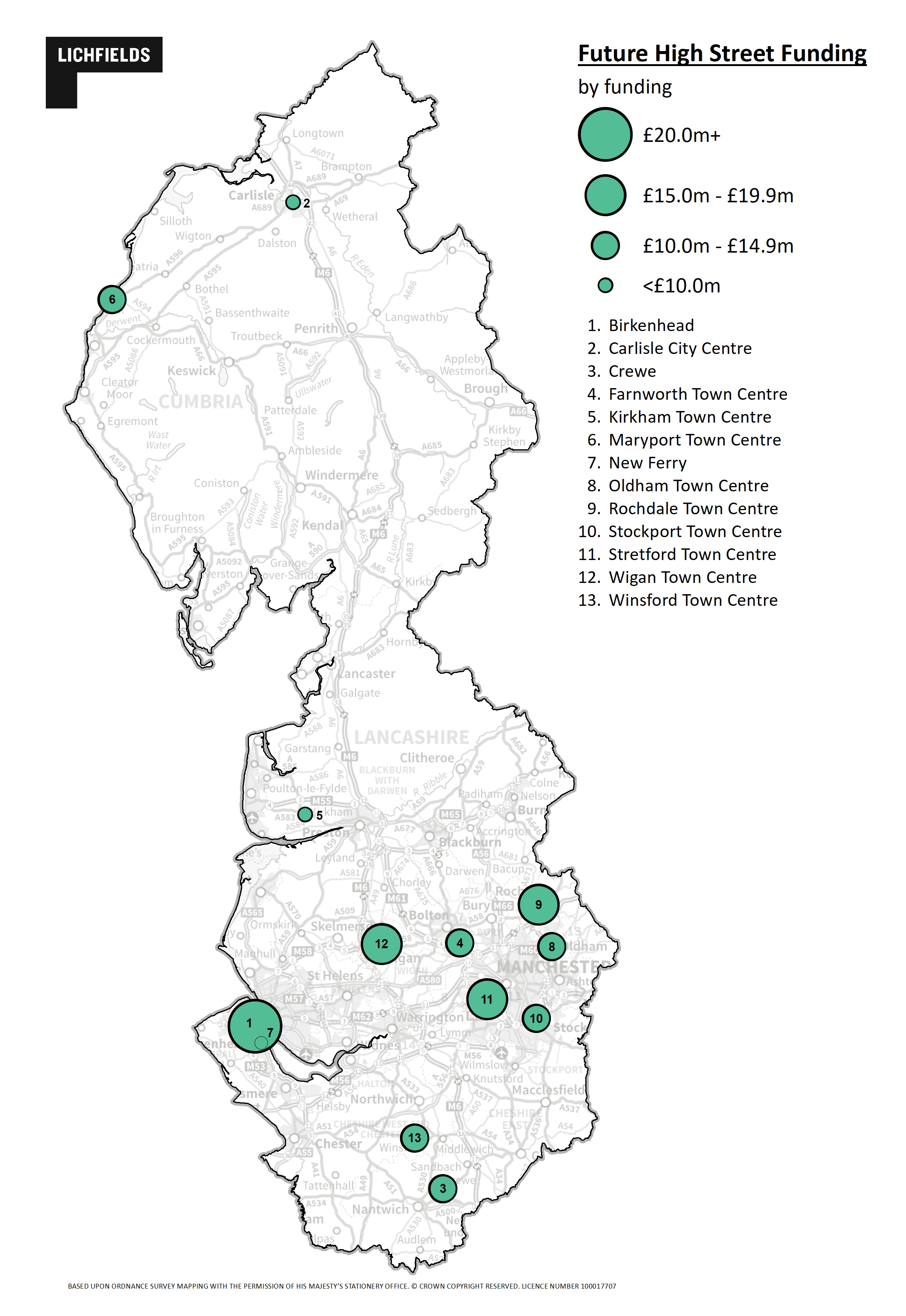
In the North-West £168 million was secured across 13 town centres. Key examples of this have included:
 
  • Stockport: Stockport’s high street has benefited from £14.5 FHSF funding. The ‘Stockroom’ project includes repurposing large areas of empty retail space in the Merseyway Shopping Centre around Adlington Walk into a mixed-use learning, culture and events space.
In Stockport, the doors opened on the repurposed shopping centre floorspace last month. It sits alongside a wider and impressive package of other town centre regeneration coming forward around the station interchange and within the town centre, which has been driven by the Stockport’s Mayoral Development Corporation (MDC). The MDC initially covered ‘Town Centre West’ since 2019, but in 2024 it was announced to be widening to include ‘Town Centre East’.
Stockport demonstrates the power of the MDC format delivering change, driving regeneration and delivering development.
The FSHF is therefore just one piece of that wider town centre regeneration puzzle. In this case, the MDC model’s ability to deliver change stands out in Greater Manchester, indeed reflecting this, Rochdale, Old Trafford, Bury and Northern Gateway, have recently been announced to set to follow the MDC model.
In Andy Burnhams words, “Approving this in principle is symbolic, and shows that we’re getting on with levelling-up places by ourselves.” 
 
2. Towns Fund
In September 2019, 101 places were invited to put forward proposals for a Town Deal as part of a £3.6 billion fund[3]. This was designed to provide towns with the tools to design and deliver a growth strategy for their area, contributing to the Government’s objective of rebalancing the national economy[4] - recognising the role that town centres can play in this.
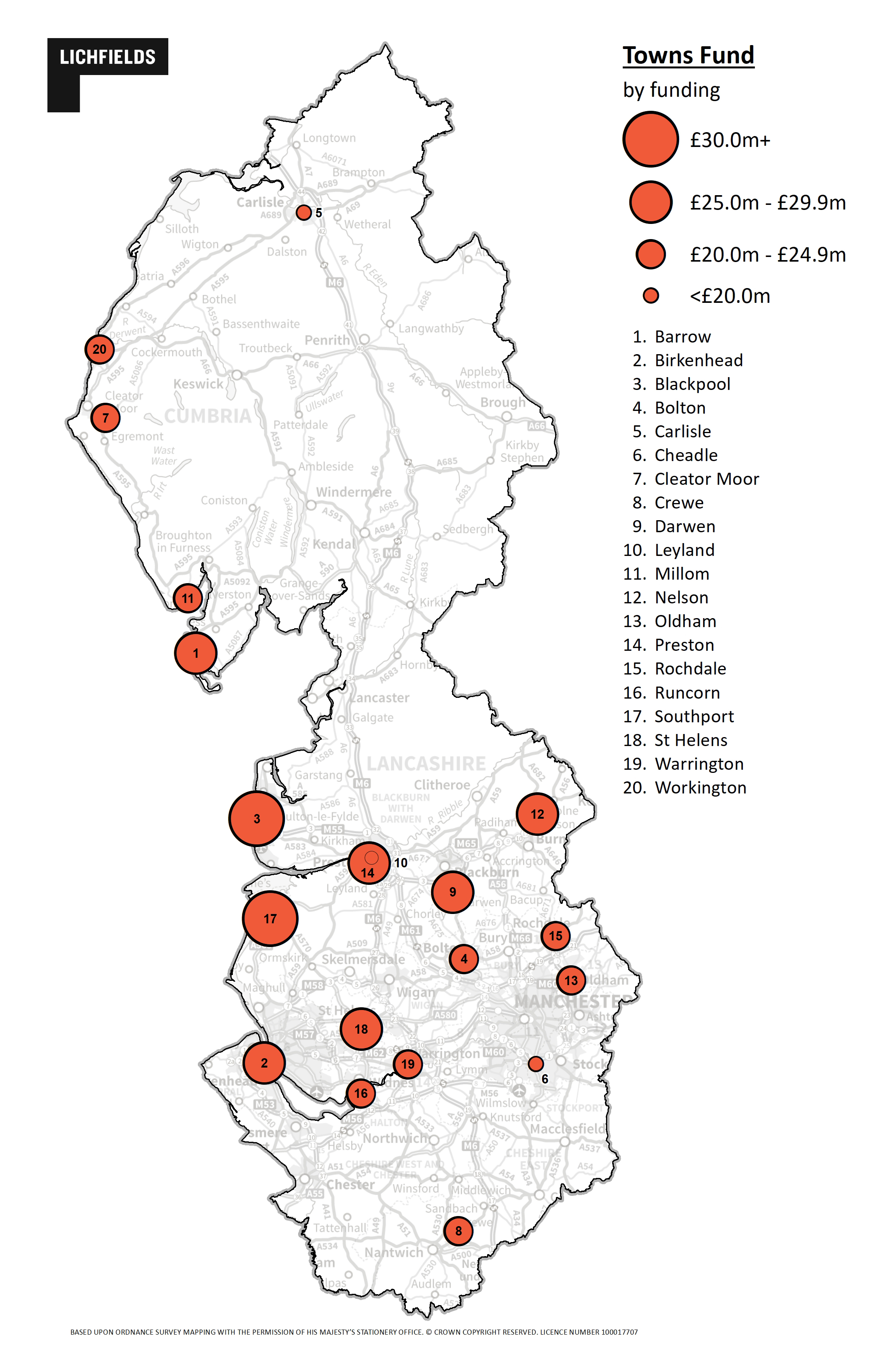
The North-West secured over £486 million of the fund across 20 allocations.  A good example of the use of this Fund is set out below.
  • St Helens: St Helens used part of £25 million of Towns Funds money to support projects related to the creation of new community spaces and cultural hubs. The first phase has been the Town Centre Living Regeneration project a joint venture with Muse, Legal and General and Homes England.
Alongside other regeneration projects, including transport improvements, the Towns Funds investment has helped to unlock investment in St Helen’s town centre and has realised potential to create a more diversified all day economy and introduce sustainable spending power with town centre living.
There has, however, been much controversy of the use of £70million funding by St Helens Council and the need to revise proposals to account for inflation costs. This has brought into question whether Local Authorities should put themselves in such a financial position to drive town centre transformation.
 
3. Levelling up Fund
A £4.8 billion fund aimed at supporting projects that drive growth in areas of the UK that are economically behind, with a strong emphasis on investment in local infrastructure to support economic recovery.
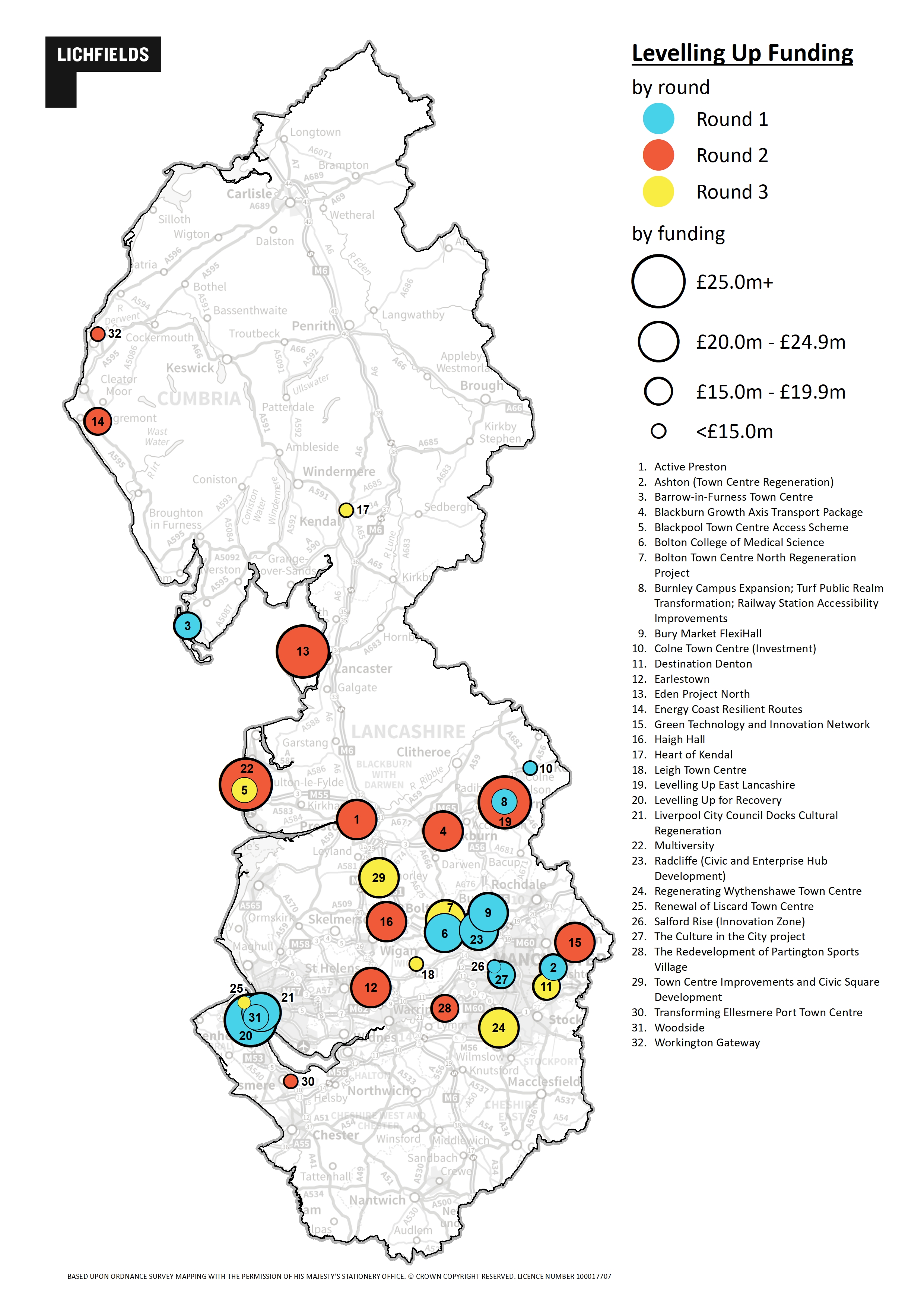
The North-West secured £570 million across 32 schemes.
  • Wythenshawe – Manchester City Council secured £20 million for regenerating Wythenshawe Town Centre in round 3 of the funding and invested £11.9 million of its own funding. Coming forward as a joint venture with Muse and Wythenshawe Community Housing Group the proposals will deliver 2,000 homes in total, the redevelopment of Wythenshawe Civic Centre, which the city council acquired from St Modwen with a view to regenerating in 2022, plans for a culture hub, food hall, public square, and more than 100,000 sq ft of flexible workspace.
The overall investment is estimated at some £500million when private and public sector funding is combined. The blend of uses proposed, including cultural uses, food space alongside new homes also looks to positively create a sustainable community and which draws in local people and visitors – and hopefully contributes to its success as it comes forward over the next 10-15 years.
 
 
4. High Street Heritage Action Zones
Aimed at supporting the preservation and regeneration of historic towns and cities, Heritage Action Zones have provided support since 2017. This led to the £95 million High Street Heritage Action Zone programme aimed at unlocking the potential of 67 historic high streets, nationally and 14 in the North-West region.
The projects aim to support economic, social and cultural regeneration. Projects have transformed disused and dilapidated buildings into homes, shops, workplaces and community spaces:
  • Lancaster: £2million heritage-led regeneration in the Mill Race Area, including the refurbishment of Grade II Listed Grand Theatre, alongside restoring and reinstating historic fabric of other historic buildings windows, shop fronts and signage, elevation treatments such as re-pointing and roofing repairs.
The investment positively reinstates parts of the cultural fabric and richness of Lancaster. This supports making it an attractive centre to visit for future generations and provides a wider draw to the town centre for visitors – ultimately increasing footfall and bringing vitality and viability.
 
The Impact of Funding: Lichfields’ View
Funding mechanisms appear to have to have the potential for wide reaching positive impacts on town centres in the North-West, both in terms of economic growth and social regeneration. In examples such as St Helens funding has helped provide a central catalyst to kick start and unlock regeneration and bring together private and public sector investment. Albeit the selected locations benefiting from investment, can be at the expense of others that might have ultimately needed it more – and as shown with Stockport there is more sitting behind town centre success than one singular project.
The highly competitive nature in bidding for some of these funds, has however, been subject to significant criticism from a number of leading local authorities who are often required to invest significant resources and public money in developing bids that ultimately may not be successful. The Local Government Association (LGA) estimate the cost of pursuing a competitive bid for funds is often in the region of £30k [5]. Those that have prepared winning bids clearly have benefited, however these have not necessarily rewarding areas most in need of regeneration funding and often the selection criteria which has determined not only ‘winners’ but equally ‘losers’ has seemed arbitrary. This has been accused by some as “leading to the opposite of levelling up”, where some areas decline further as others allocated funding gain strength[6].
A further challenge is that schemes have been slower to deliver than expected, beset by inflationary costs and, in some cases project specific issues.  The impact of the pandemic on spending has also been cited as key metric which has delayed positive impacts been realised sooner. For those working in planning and development sector uncertainty challenges with timescales and delivery is not necessarily surprising, but critics have noted that when spending from the public purse understanding the readiness of projects should be better understood.
Delays in delivery has also been criticised, despite choosing apparently “shovel ready” projects, Parliamentary review showed 80% of the Levelling Up Fund Round 1 projects were set to miss their March 2024 completion deadline [5]. This has led to the Government to have to introduce more flexibility around deadlines; and much renegotiations by Local Authorities.
In order to fully understand the benefit arising from the central Government investment, there has also been recommendations to better measure progress with projects, as well as the longer-term impacts for town centres, for example over 5, 10 or 15 years [5].
 
Conclusion
Town centre regeneration in the North-West of England has benefited from targeted government funding. With continued investment and collaboration from local authorities and key town centre stakeholders, the North-West town centres can emerge stronger, more sustainable, and more vibrant than ever before.
The Future High Streets Fund, High Street Heritage Zones and Town Deals are from the new Labour Government’s perspective committed projects with positive legacies, but which financial link is coming to a close. The Autumn budget confirmed previously committed funding for core Levelling Up Fund projects – providing £1.0 billion will be delivered in 2025-26. It also committed to reforming growth funding with Phase 2 of the Spending Review, including rationalising the number of funds and moving away from competitive bidding for funds and supporting local leaders to drive growth.
Any plans emerging are likely to seek to learn lessons from the previous approach. If funding streams for town centres are rationalised, perhaps other delivery vehicles for regeneration - Development Corporations, Mayoral Development Zones, Compulsory Purchase, Local Development Orders - will increase in prominence.
We will await further updates in the Spending Review - either way the North-West continues to be a region with great potential.
Lichfields toolkit – Revitalise – provides local authorities and other stakeholders with a range of services to help transform town centres across the country, combing town centre and economic expertise. Revitalise is designed to:
  • develop a robust evidence base, informing tailored interventions to unlock a centre’s potential
  • provide a strategic framework for new investment which responds to the opportunities identified
  • develop compelling business cases and bids to unlock funding and deliver change
  • assist stakeholders in delivering the new investment needed to transform town centres
Please do get in touch if you would like to discuss any of your potential town centre projects.
 
 
Footnotes


[1] Future high streets fund

[2] Debate on regeneration of city, House of Commons Library, October 2024

[3] https://townsfund.org.uk/

[4] Towns Fund prospectus

[5] Levelling up funding to Local Government, House of Commons Committee of Public Accounts Twenty-First Report of Session 2023–24, March 2024

[6] Supporting our high streets after COVID-19, House of Commons Levelling Up, Housing and Communities Committee, December 2021


CONTINUE READING